
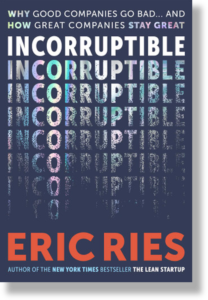
In May 2026, Eric Ries – the entrepreneur behind The Lean Startup and founder of the Long-Term Stock Exchange – published Incorruptible: Why Good Companies Go Bad… and How Great Companies Stay Great. The book advocates for structuring a company in a way that legally protects it from the inevitable pressures of what Ries calls “financial gravity” – the deeply engrained instinct to concede power to those who control financial capital. Ries says financial gravity results from our millions of years of evolutionary history when we “survived by tracking who controlled resources and adjusted [our] behavior accordingly.”
Ries started an online community for people interested in the book. In the community, legal templates are shared. These templates, especially the company charter, contain a combination of protections that companies committed to staying true to their missions can adopt.
Incorruptible Company Charter Provisions
Here are some of the provisions in the charter:
- The model charter is for a Delaware public benefit corporation.
The PBC statute is designed to protect the board if they choose to sell to a values-aligned buyer that is not the highest bidder.
- It authorizes “mission shares.”
These shares are designed to be granted to a “Mission Guardian Entity” like a perpetual purpose trust, cooperative, or nonprofit. Whoever holds the mission shares gets to elect one board member – the “Class M Director.” This Director has majority control over the board of directors thanks to the following provision: “Each director shall be entitled to one (1) vote on each matter presented to the Board of Directors except for . . . the Class M Director, who shall be entitled to N+1 votes, where N is equal to the total number of directors on the Board including the Class M Director.”
- Certain actions cannot be taken without the Mission Guardian Entity’s consent.
That list includes eliminating the company’s PBC status, changing or removing the mission itself, dissolving the company, merging or selling it, changing what business the company is in, and approving the CEO’s pay or firing them without cause.
- Founders have supervoting shares.
But if a founder engages in fraud, self-dealing, or other serious misconduct, there is a mechanism for stripping them of their supervoting shares and remove them from the board.
Our Take on the Incorruptible Charter
The Jason Wiener PC legal team has been designing entity structures for mission preservation for decades and have used the strategies in this charter many times – founder golden shares, control by a steward entity such as a perpetual purpose trust or nonprofit, and public benefit corporation status, as well as other tools like forming under more values-aligned statutes, enshrining cooperative principles, and many more.
I believe that the best tool for making sure a company stays incorruptible is creative and thoughtful design of the investment terms.
If investors only get paid when a company has an exit (i.e. sale to a larger company or initial public offering), all the well meaning charter provisions in the world may not be strong enough to survive the pressure to grow the company to achieve the highest possible valuation as fast possible.
There is no need to structure investments this way! There are an infinite number of ways to structure an investment so that investors benefit from profitability without the need for an exit – a company that is built to last instead of built to flip, as Jim Collins describes it.
So, if you want to build your company to be incorruptible, don’t just incorporate creative governance provisions into your charter – structure your investment terms to align your investors’ financial interests with your plans to grow a healthy, sustainable, and profitable company that can last for generations.
***
Disclaimer: The information contained in this article is for general informational purposes only and does not constitute legal advice. The content provided should not be relied upon as a substitute for consultation with a qualified attorney. For specific legal questions or situations, please consult with a licensed legal professional who can provide advice tailored to your particular circumstances.
